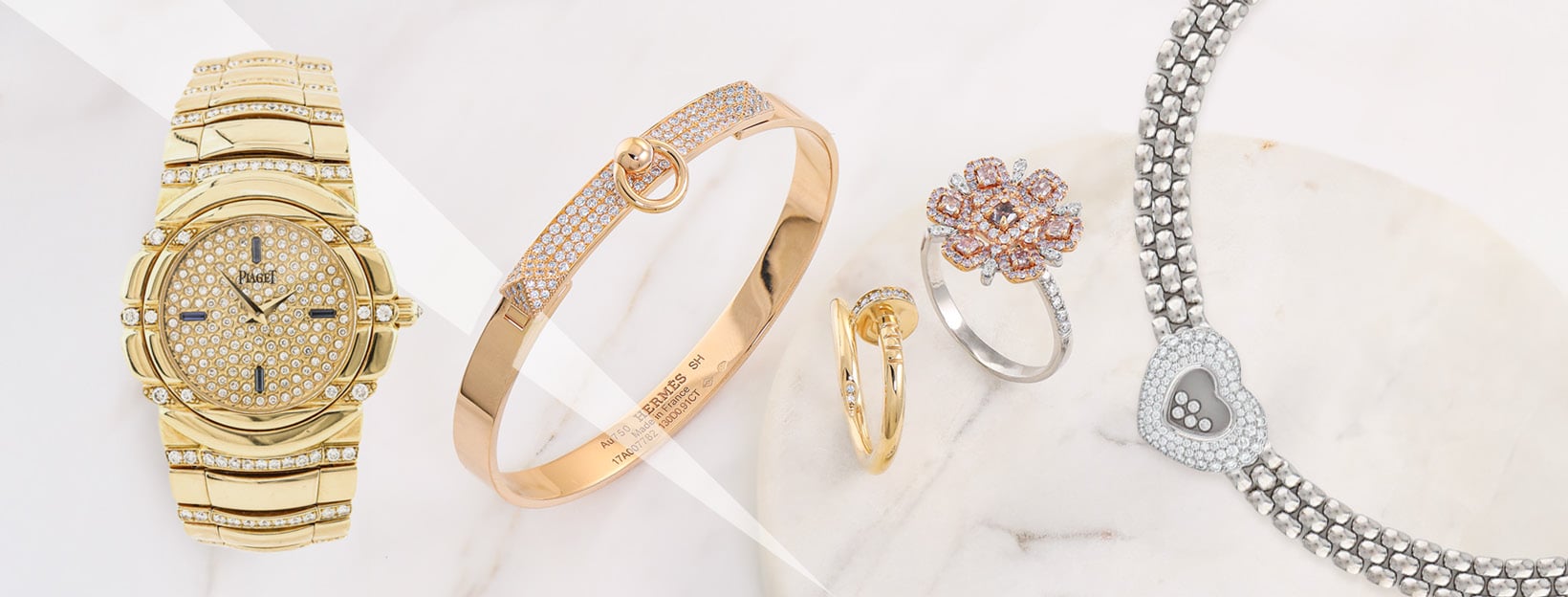

Introduction to Diamonds
There is not a lot to say about the diamond that hasn't already been said. Perfectly formed, natural and the subject of worldwide obsession, the diamond is truly a thing of beauty.
Unbreakable Fascination
The hardest gemstone known to man, it clocks in with a 10 out of 10 on the Mohs Scale — making it ideal for industrial uses, while its high dispersion of light gives it a 'fire' that creates some of the most breathtaking jewellery ever seen!
A diamond's history is long — first sought in India over 3000 years ago and used as the ultimate 'engagement stone' since Ancient Egyptian times. However it was a 1940s advertising campaign by jewellers De Beers, proclaiming that "diamonds are forever," that truly set demand on fire. Today, around a third of the world's supply, by volume, comes from the Argyle mine in Western Australia.
The most popular diamonds may be clear/white, yet they also occur naturally in a range of other colours. Specifically, the pink diamond has become a firm favourite, along with cognac, champagne and yellow diamonds (one of the most common colours to appear in natural diamonds). Green diamonds are extremely rare. When it comes to coloured diamonds, the more distinct and pure the colour, the rarer the diamond. Only 20% of all gems mined are used for gemstone purposes.
Your Diamond
Representing 'winter', a diamond possesses a fiery glow simply not found elsewhere.
The most common measure of quality for your diamond is the '4 Cs' — cut, colour, clarity and carat.
- —Cut is the shape that the diamond has been cut into. The most popular shape is the Round Brilliant cut, but other common cuts include the Princess cut, Emerald Cut and the Marquise Cut.
- —Colour is set on a scale and applies to all 'white' diamonds, ranging from D (which is colourless) to Z, (which is yellow).
- —Clarity refers to the amount of inclusions, and their visibility. The clarity scale ranges from IF (internally flawless) to P3 (inclusions). Inclusions can affect the light passing through the diamond, which in turn affects how fiery your diamond can be.
- —Carat refers to the weight of the diamond. One carat equals 200 milligrams in weight. For diamonds under one carat, each carat is divided into 100 points (e.g 1/2 ct = 50 points).
Being one of the most valuable stones on the planet, care is vital to keep your investment sparkling. We recommend that you have your diamond cleaned professionally every two years.
Notable Diamonds
There are many! The world's largest colourless specimen is the 273 carat 'De Beers Centenary Diamond', heart-shaped brilliant cut and graded a perfect D/IF. Elizabeth Taylor was renowned for her large diamonds, including her 33 carat Krupp diamond and a 69.42ct pear-shaped diamond from Richard Burton, and a heart-shaped yellow diamond that originally belonged to Mumtaz Mahal, the inspiration for the Taj Mahal, in 1621.